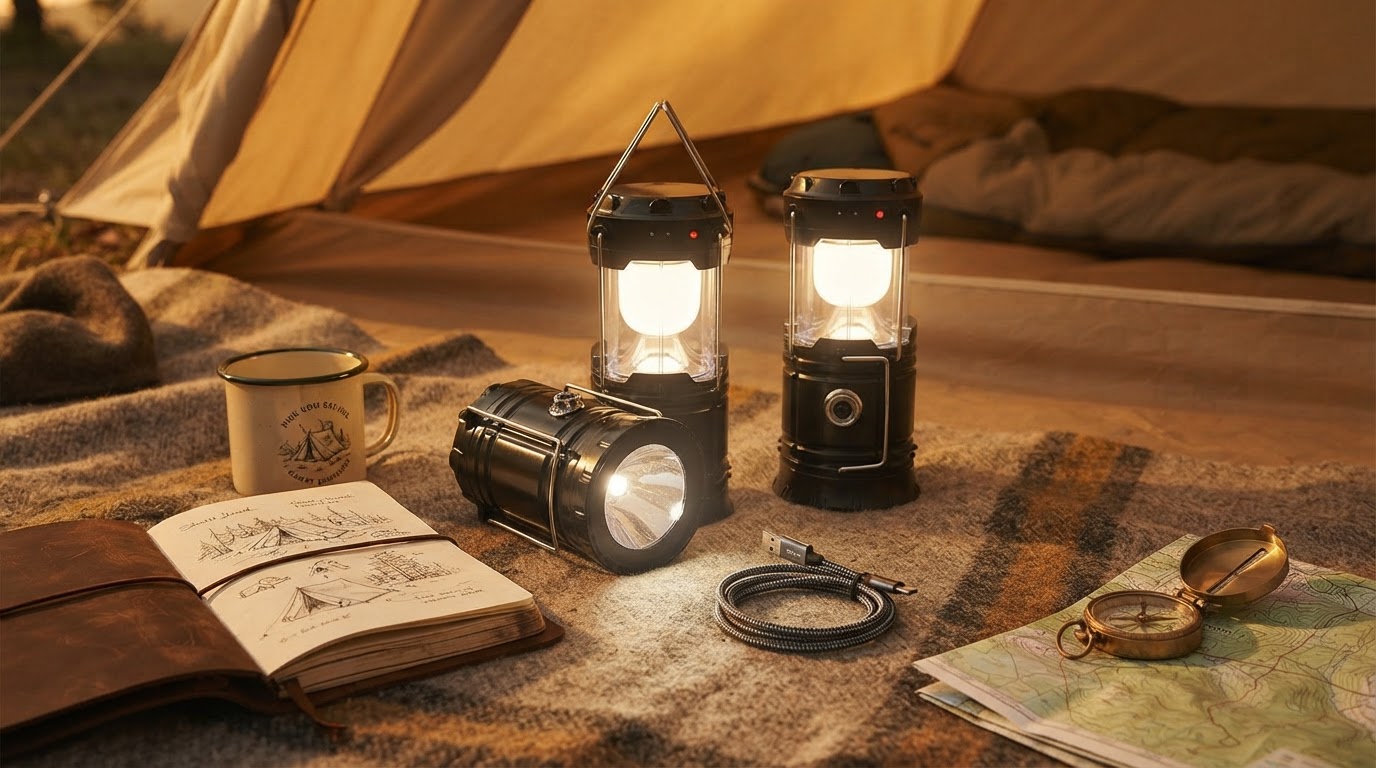
Optimizing Tent Lighting with Led Camping Lantern Hardware
 Daniel OkaforField Tester
October 15, 2026. This review examines the shift toward USB-C standardization in portable tent lighting and its impact on gear weight and reliability. It is written for campers who need efficient, high-output illumination without the bulk of proprietary charging cables.
The Friction of Outdated Charging Standards
I spent years managing a chaotic mess of Micro-USB, Mini-USB, and proprietary barrel plugs in my gear bin. The transition to USB-C isn't just a matter of convenience; it is about the structural integrity of the charging port and the speed at which a high-capacity cell can recover. When I am three days into a trek, the last thing I want to worry about is a fragile port snapping off inside the housing or waiting six hours for a trickle charge. According to Fenix Lighting, the move to USB-C allows for faster recharging of high-capacity batteries, which is essential when your lighting serves as a primary safety tool. I tested this for four nights in the Cascades, where the dampness and cold usually drain battery life faster than the manufacturer specs suggest. The physical durability of the USB-C interface proved superior to the older standards, which often felt loose after just a few dozen cycles. When you are fumbling in a dark tent with cold fingers, the reversible nature of the USB-C plug saves more than just time; it prevents the accidental damage that often sidelines cheaper, non-standardized lights. This reliability is a core component of a modern rechargeable camping light, where the goal is to minimize points of failure in the field.
Performance of the Led Camping Lantern System

Photo by Onur Polat on Pexels
What surprised me: the efficiency of the internal power management when paired with a high-speed PD (Power Delivery) source. I ran the Led Camping Lantern through a series of full-drain cycles to see how the thermal regulation handled the increased current of a USB-C input. Unlike older models that would get alarmingly warm near the charging circuit, the heat dissipation here remained stable. Day three is where I noticed the real benefit: I was able to top off the lantern from a portable power bank during a thirty-minute lunch break, gaining enough runtime for another full evening of area lighting. This is a significant step up from the legacy hardware found in a compact solar flashlight lantern combo, which often relies on much slower photovoltaic inputs or older USB standards. The light quality inside the tent remained consistent even as the battery dipped below twenty percent, avoiding the flickering that plagues low-end LED drivers. I found that hanging the unit from the central gear loft provided a clean, 360-degree spread that didn't cast the harsh, blue-tinted shadows common in budget hardware. The integration of a high-output USB-C port also means I can carry a single high-wattage cable for my phone, GPS, and lighting, effectively stripping half a pound of redundant wires from my pack. Here's the moment it earned its place: I accidentally knocked the unit onto a granite slab while reaching for my sleeping bag. The port remained perfectly aligned, and the light didn't skip a beat. That kind of physical resilience is what separates a dedicated field tool from a household novelty.
Evaluating Your Tent Lighting Requirements

Photo by Tima Miroshnichenko on Pexels
Choosing a USB-C light requires looking past the lumen count and focusing on the electronics housing and battery chemistry. I have seen many units fail not because the LED died, but because the charging controller couldn't handle the voltage fluctuations of a portable solar panel or a cheap power bank. In a recent review of Top Rechargeable LED Camping Lights by YouTube creators, the emphasis was placed on lighting modes and tripod mounts, but for my use case, the port weather-sealing is the most critical factor. What I'd do differently next time is prioritize a unit with a slightly larger battery capacity even if it adds an ounce, as the fast-charging capabilities of USB-C make that extra weight negligible in the long run. When you are looking for a rechargeable camping light that will actually last through a season of heavy use, you need to verify the ingress protection rating around the charging port itself. A compact solar flashlight lantern combo is great for emergencies, but for primary tent illumination, the dedicated USB-C rechargeable unit is the superior choice for consistent output.
Before you commit to a new lighting setup, use this checklist to ensure the hardware meets the demands of actual field use:
- Verify the port is a true USB-C interface with a reinforced internal mounting bracket.
- Look for a rubberized gasket or port cover that stays secure even when the unit is bumped or shaken.
- Check for Power Delivery (PD) compatibility to ensure the light can handle higher-wattage chargers without overheating.
- Confirm the battery is a high-density lithium-ion or lithium-polymer cell for better cold-weather performance.
- Ensure the light offers a warm-white or high-CRI mode to reduce eye strain inside the enclosed space of a tent.