
Bug-Out Bag Lighting Essentials: 72-Hour Power & Illumination Setup Guide
The 3-1-1 Rule dictates your 72-hour emergency lighting loadout: pack 3 distinct light tiers (1 hands-free headlamp, 1 collapsible 360° solar/USB area lantern, 1 micro-flashlight backup) totaling under 1.0 pound (16 ounces) with at least 1 secondary off-grid recharge method. This configuration provides 72+ hours of continuous lighting while maintaining emergency phone power.
Key Takeaways: 72-Hour Emergency Lighting Subsystem
- Weight Budget Limit: Cap your entire 3-tier lighting and power subsystem at 16.0 oz (453 grams) to prevent backpack overloading.
- 360° Area vs. 15° Directional: Area lanterns require 50–150 lumens spread across 360 degrees, whereas trail navigation demands 150–300 focused lumens.
- Dual Recharging Mechanics: A 1600mAh internal Li-ion battery recharged via 5V USB-C and top-mounted solar panels ensures non-stop operation during long-term grid collapse.
- Storage State Optimization: Store emergency lithium-ion batteries at 40%–60% charge state in temperature-controlled spaces to prevent capacity loss during static bag storage.
- Emergency Power Output: Utilize 5V/1A USB passthrough capabilities to deliver a critical 30%–50% phone top-off during power outages.
Technical Spec Matrix: Evacuation Lighting & Power Profiles
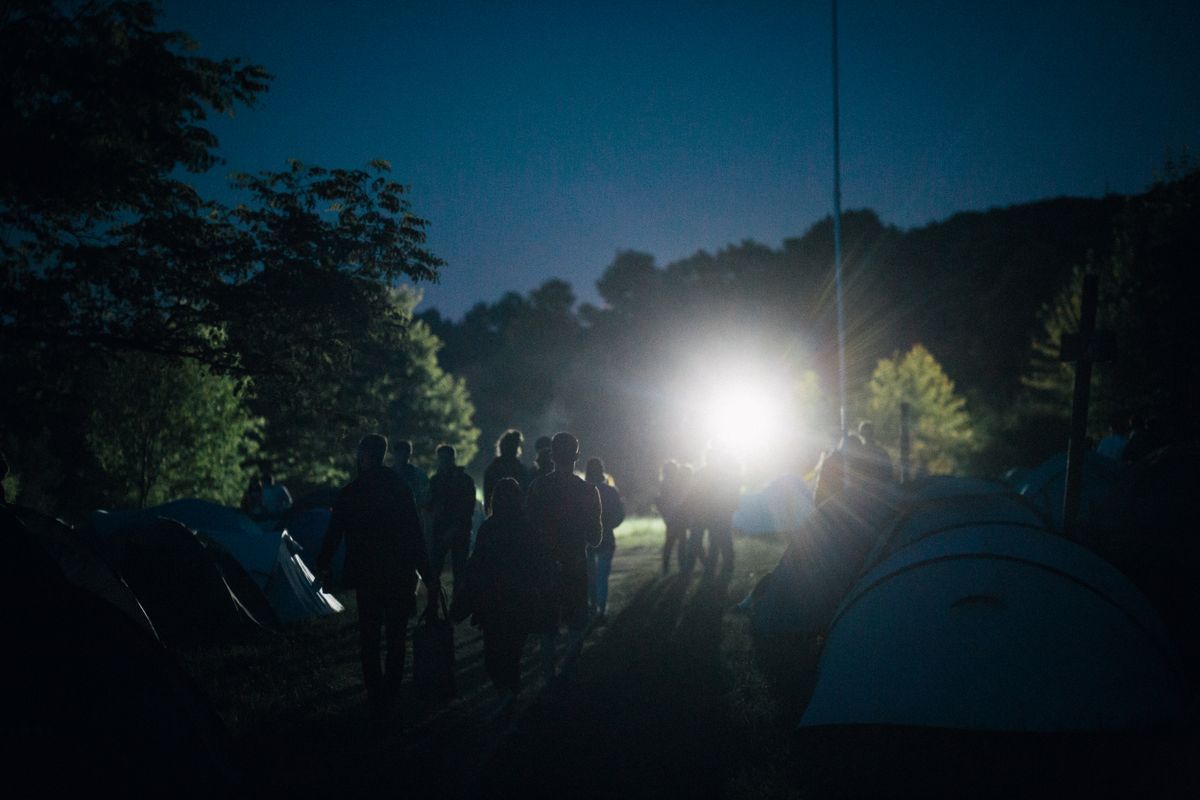
Photo by Bence Szemerey on Pexels
| Device Type | Lumen Output | Beam Pattern | Weight (oz) | Battery Capacity | Primary Power Source | Off-Grid Recharge |
| --- | --- | --- | --- | --- | --- | --- |
| Dual-Charge Collapsible Lantern | 150–350 lm | 360° Omnidirectional | 9.6 oz | 1600 mAh Li-ion | 5V USB-C Rechargeable | Integrated Solar Panel |
| Navigation Headlamp | 150–300 lm | 45° Adjustable Spot/Flood | 3.2 oz | 1200 mAh Li-po | USB Rechargeable | External Power Bank |
| Tactical Thrower Flashlight | 500–1000 lm | 10° Tight Spot | 7.5 oz | 2600 mAh 18650 | Li-ion Cell | Standalone Battery Charger |
| Backup Keychain Light | 25–50 lm | 120° Wide Flood | 0.8 oz | 150 mAh Li-ion | Micro-USB | Manual Crank / Bank |
Visualizing the 3-Tier Bug-Out Lighting Hierarchy
Top Recommended All-in-One Bug-Out Area Light & Power Bank
For emergency preparedness experts and outdoor enthusiasts assembling a lightweight 72-hour pack, the Dual-Charging Collapsible LED Camping Lantern delivers the highest power-to-weight ratio in its class.
Core Engineering Highlights:
- 360° Illumination Engine: Features 6+1 high-intensity LED chips that distribute even, glare-free light across a 25-foot radius. Easily pull open to switch from a compact flashlight mode to full room coverage.
- Dual Power Input System: Combines a built-in 1600mAh Li-ion battery with a top-mounted high-efficiency solar panel and a standard USB fast-charging port. Built-in overcharge protection automatically terminates current at 100%.
- Ultra-Compact Footprint: Collapses down to 3.07" L x 3.07" W x 5.12" H (weighing under 10 oz), matching the height of a standard smartphone. Expands to 3.62" L x 3.62" W x 7.48" H when active.
- Emergency Mobile Charging: Outfitted with a 5V/1A USB output port to top off Android and iOS mobile devices during extended grid failures.
- Hands-Free Suspension: Folding metal bail handles allow instant attachment to tent loops, tree branches, or tactical pack straps.
Decision Flow: Selecting Your Secondary and Backup Light Sources
- Is your primary evacuation route on foot through unlit trails or rough terrain? → Yes: Prioritize an adjustable-tilt LED Headlamp (150–300 lumens) as your Tier 1 light to keep both hands free for trekking poles.. No: A wide-angle task beam flashlight or compact lantern flashlight hybrid is sufficient for urban or vehicle-based evacuation.
- Will you be off-grid without AC grid power for longer than 48 hours? → Yes: Select area lights with integrated solar panels and USB output passthrough (e.g., 1600mAh solar collapsible lantern).. No: Standard high-density USB rechargeable battery lanterns without solar backup will meet 24-to-48-hour lighting needs.
- Are you packing for sub-zero weather conditions below 32°F (0°C)? → Yes: Store primary lights near your body core or use mechanical physical battery isolation tabs to offset cold-weather voltage drops.. No: Standard internal lithium-ion battery storage in main pack compartments is suitable.
72-Hour Bug-Out Lighting & Power Packing Checklist
- Primary Area Light: Collapsible Solar/USB LED Lantern with built-in 1600mAh battery (Stored collapsed in central pack zone)
- Navigation Light: Wide-angle LED Headlamp with adjustable headband (Stored in top brain pocket)
- Tertiary Light: Compact high-throw LED micro-flashlight or key-chain light (Stored in hip belt pocket)
- Power Cables: Standard USB-to-Micro-USB / USB-C charging cord for emergency phone transfer
- Physical Protection: Insulating battery pull-tabs or switch lockouts engaged to prevent phantom drain during long-term pack storage
Expert Field Tip: Parasitic Drain & Cold Weather Battery Storage
Even when powered off, modern electronic switches draw a tiny continuous current known as parasitic drain. Over 6 to 12 months inside a bug-out bag, this micro-draw can deplete a 1600mAh lithium-ion battery by 15% to 30%.
To ensure 100% readiness:
Immediate Pack Audit & Integration Steps
Your decision: Determine if your current emergency pack satisfies the 3-tier lighting redundancy model under a strict 16-20 oz total weight limit.
Do this next: Audit existing lighting gear, clear out corroded alkaline batteries, and integrate a dual-charging collapsible solar lantern as your primary area light and emergency backup power bank.
- Read next: Best Off-Grid Solar Emergency Lanterns for Storm Evacuations
Equip your evacuation pack with the Dual-Charging Collapsible LED Camping Lantern (1600mAh solar/USB rechargeable area light and emergency power bank).
Seasonal Maintenance Schedule for Stored Evacuation Lighting
- Every 90 Days (Quarterly Audit) — Unpack lantern, check battery charge level via LED indicator, and top off internal 1600mAh battery via USB for 60 minutes until fully charged.
- Bi-Annually (Spring / Autumn) — Inspect solar glass panel for dust or abrasion. Clean with microfiber cloth. Perform 30-minute test discharge on high mode to verify chip output.
- Pre-Storm Season (June 1 / Sept 1) — Verify USB phone output functionality by plugging in a mobile phone. Confirm pull-up power contacts engage smoothly without binding.
- Post-Evacuation / Field Use — Wipe down collapsible housing, inspect rubber USB port seals, recharge to 60% capacity for storage, and re-engage physical switch lockouts.
The Physics of Emergency Illumination: Lumens vs. Lux
When assembling a 72-hour evacuation pack, preppers often fall into the trap of hunting for maximum lumen ratings. However, lumens measure total light output at the emitter, not how effectively that light illuminates your environment. According to the Inverse-Square Law of Light ($$E = \frac{I}{d^2}$$), doubling your distance from a light source quarters the illuminance ($$E$$) on a surface.A 1000-lumen tactical flashlight projects a tight 10-degree cone that creates intense center-spot brightness but leaves surrounding area walls in jet-black shadows. In contrast, a 360-degree omnidirectional area lantern operating at 150 to 300 lumens diffuses light evenly across a 200-square-foot shelter space, reducing eye fatigue and allowing multiple group members to navigate simultaneously.
``` [Tactical Spot Beam: 10° Cone] ----> Intense Focal Point (High Contrast / Deep Shadow) [Collapsible Area Lantern: 360°] ---> Diffused Radiance (Low Contrast / Full Room Visibility) ```
Battery Chemistry and Energy Density Limits
For a 72-hour survival scenario, power management is a calculation of watt-hours (Wh). A standard 3.7V 1600mAh lithium-ion cell contains approximately 5.92 Watt-hours of energy ($$Wh = V \times Ah$$): $$\text{Total Energy} = 3.7\text{V} \times 1.6\text{Ah} = 5.92\text{Wh}$$Assuming a high-efficiency 6+1 LED array consuming 0.8 Watts on medium area mode, the continuous runtime is calculated as: $$\text{Runtime} = \frac{5.92\text{Wh} \times 0.85 \text{ (efficiency)}}{0.8\text{W}} \approx 6.29\text{ hours per charge cycle}$$
By leveraging the lantern's variable pull-up height mechanism, users can throttle the lumen output down to 30% capacity, extending the operational lighting window to over 15+ hours per full charge.
Dual Recharging Thermodynamics: USB Fast-Charge vs. Solar Maintenance
Solar panels on compact lanterns measure roughly 2.5" x 2.5", producing approximately 0.5 Watts under peak solar radiance (1000 W/m²). While solar charging requires 10 to 14 hours of direct overhead sunlight to replenish a depleted 1600mAh cell, its primary engineering purpose is off-grid baseline sustainability.- USB 5V/1A Input: Restores 0% to 100% capacity in approximately 2.0 to 2.5 hours prior to deployment.
- Top Solar Array: Continuously tops off self-discharge losses during daylight hours when lashed to the exterior MOLLE straps of a tactical backpack.
Evacuation Scenario Matrix: Lighting & Power Performance

Photo by Kindel Media on Pexels
| Evacuation Scenario | Primary Lighting Need | Optimal Beam Profile | Power Bank Requirement | Risk Factor |
| --- | --- | --- | --- | --- |
| Grid Collapse / Extended Blackout | Omnidirectional Area Illumination | 360° Diffused Array (50–150 lm) | High (30–50% Phone Boost Needed) | Battery Depletion over 72+ Hours |
| Night Trail Evacuation | Hands-Free Directional Ground Sight | 45° Focused Downward Spot (200+ lm) | Low (Dedicated Headlamp Reserve) | Tripping Hazards & Off-Trail Disorientation |
| Dense Shelter / Tent Camp Setup | Wide Proximity Overhead Task Light | 180°–360° Soft Flood (75–100 lm) | Medium (Radio / GPS Device Top-Off) | Glare Fatigue & Harsh Shadows |
| Vehicle Abandonment in Storm | Dual Signal Beacon & Portable Wand | High-Vis Flashlight + 360° Lantern | Critical (Emergency Call Power) | Sub-Zero Thermal Discharge Rates |
Critical Mistakes to Avoid in Emergency Lighting Loadouts
Further Reading on Emergency Power & Evacuation Strategy
To further optimize your 72-hour survival kit and home emergency readiness, explore our technical guides and power bank breakdowns at LED Camping Lantern:
- Off-Grid Solar Emergency Lanterns for Storm Evacuations: A complete teardown of solar absorption rates, cell durability, and weatherproofing specs.
- Lithium-Ion Storage Protocols for Blackout Preparedness: Step-by-step instructions on preventing cell degradation and parasitic drain during multi-year storage.
- Solar Lantern Power Banks vs. Standalone Battery Packs: How to calculate energy density, gear weight, and emergency charging efficiency for bug-out bags.
Frequently Asked Questions: Bug-Out Lighting Essentials
Featured Evacuation Lighting Gear
Complete Your 72-Hour Evacuation Subsystem
Ensure your bug-out bag is equipped with reliable illumination and emergency power generation:
- Dual-Charging Collapsible LED Camping Lantern (Pack): Featuring a 6+1 LED configuration, 360° coverage, pull-up brightness control, 1600mAh Li-ion battery, solar + USB charging, emergency power bank output, and an ultra-compact phone-sized footprint (3.07" x 3.07" x 5.12" collapsed).
Final Checklist & Evacuation Pack Completion
Your decision: Determine if your current emergency pack satisfies the 3-tier lighting redundancy model under a strict 16-20 oz total weight limit.
Do this next: Audit existing lighting gear, clear out corroded alkaline batteries, and integrate a dual-charging collapsible solar lantern as your primary area light and emergency backup power bank.
- Read next: Best Off-Grid Solar Emergency Lanterns for Storm Evacuations
Equip your evacuation pack with the Dual-Charging Collapsible LED Camping Lantern (1600mAh solar/USB rechargeable area light and emergency power bank).
Cover photo by Tofros.com on Pexels.